

Gênero e Número: Understanding anti-gender discourse on YouTube: a feminist approach to AI-powered monitoring
Project: Uncovering Gendered Disinformation on YouTube
Newsroom size: 10 - 20
Solution: An AI-powered tool that maps and analyses anti-gender disinformation on YouTube, helping researchers, journalists, and activists understand how harmful narratives against women and LGBTQ+ communities spread online.
Gênero e Número, a Brazilian media outlet dedicated to covering gender, race, and inequality, joined forces with Novelo Data to tackle one of today’s most pervasive threats: anti-gender disinformation. Their project seeks to map and understand how narratives targeting women and LGBTQ+ people spread on YouTube, especially during politically sensitive moments such as elections.
For the first time, Género e Número is using AI to expand its capacity to monitor and analyse online content. The partnership combines the newsroom’s editorial expertise with Novelo’s technical know-how, creating a platform designed not just for internal use but also to support researchers, journalists, and activists with accessible, data-driven insights.
The problem: Mapping the opaque disinformation flows
The idea grew out of Gênero e Número’s 2019 investigation O Reino Sagrado da Desinformação, which exposed how political, religious, and media actors coordinated disinformation campaigns on X. That investigation relied on painstaking manual analysis. With YouTube now central to Brazil’s digital debate, and with elections on the horizon, the team knew manual methods would no longer suffice.
“We realised we needed to better understand how these narratives circulate, who is targeted, what formats generate the most engagement, and how they reinforce each other,” said Vitória Régia da Silva, Executive Director of Gênero e Número.
Unlike explicit hate speech, anti-gender discourse often hides behind humour, cultural references, or visual cues. Detecting and categorising these subtleties at scale was the challenge that led the team to adopt AI.
Building the solution: From concept to prototype
The collaboration followed an iterative path. Novelo Data led the technical side, testing and discarding early prototypes before arriving at a stable system. Each step helped refine the project’s scope.
The workflow now runs through a modular pipeline hosted on Amazon Web Services: extracting metadata, transcribing audio, analysing transcripts, and classifying results. An open-source Python library developed by Novelo simplifies access to YouTube’s API. On the frontend, a JavaScript interface built from Figma designs makes the platform usable for non-technical collaborators.
“We designed an integrated pipeline that transforms videos into audio, transcribes them, and then classifies their content using AI models,” explained Guilherme Felitti, Founder of Novelo Data. “It’s modular and scalable, which means we can adapt quickly.”
Collaboration across disciplines
The project brought together two distinct but complementary worlds. From Gênero e Número, da Silva coordinated the editorial vision, joined by researchers and a designer shaping usability. From Novelo, Felitti oversaw data extraction and architecture, supported by specialists in classification, backend, and frontend development.
Bridging the technical – editorial divide was crucial. Felitti, who has a background in journalism, emphasised the need for open communication: “Technology can be intimidating. We made it clear from the start: ask us anything. We’ll explain it as many times as needed.”
For da Silva, this sense of alignment went beyond workflow: “We’ve worked with technical partners before, and it’s often a struggle. But with Novelo, we felt aligned — not just on workflow, but on values.”
Challenges along the way
Narrative complexity: Anti-gender discourse is rarely explicit. The team had to build a framework to detect indirect strategies, identifying three key dimensions — themes, strategies, and subjects — to structure the analysis.
Project scope: Initial ambitions proved too broad. “We don’t do this because it’s easy — we do it because we thought it would be easy,” Felitti joked. The team decided to prioritise an MVP that “does one thing very well.”
Workflow coordination: With editorial and technical contributors working in parallel, coordination became as challenging as the technology itself.
The opportunities: What comes next for the team
For Gênero e Número, the project marks a new chapter: its first experiment with AI applied to feminist and anti-racist journalism. “This opens the door for us to integrate AI into journalism in Latin America,” said da Silva.
They also launched two products: the Gênero e Número AI Policy, and “Anti-Gender Discourses on Social Media: A Practical Guide to Recognize, Investigate, and Contextualize Anti-Gender Narratives” — an unprecedented publication that brings together concepts, references, and strategies for those seeking to understand how anti-gender narratives operate and how to investigate them in digital environments.
Looking forward, the team envisions a self-sustaining platform with features like keyword search, richer data visualisations, and granular filters. With elections approaching, the potential impact is clear: equipping journalists and civil society with better tools to track harmful narratives.
Lessons for newsrooms
AI needs human framing: Algorithms alone do not explain disinformation. Editorial framing remains essential to give meaning to the data.
Disinformation is strategic: The project reinforces that anti-gender narratives are not accidental. Patterns show coordination, timing, and intent.
Platforms fall short: By surfacing harmful content, the project also underscores the responsibility of platforms to act.
Explore Previous Grantees Journeys
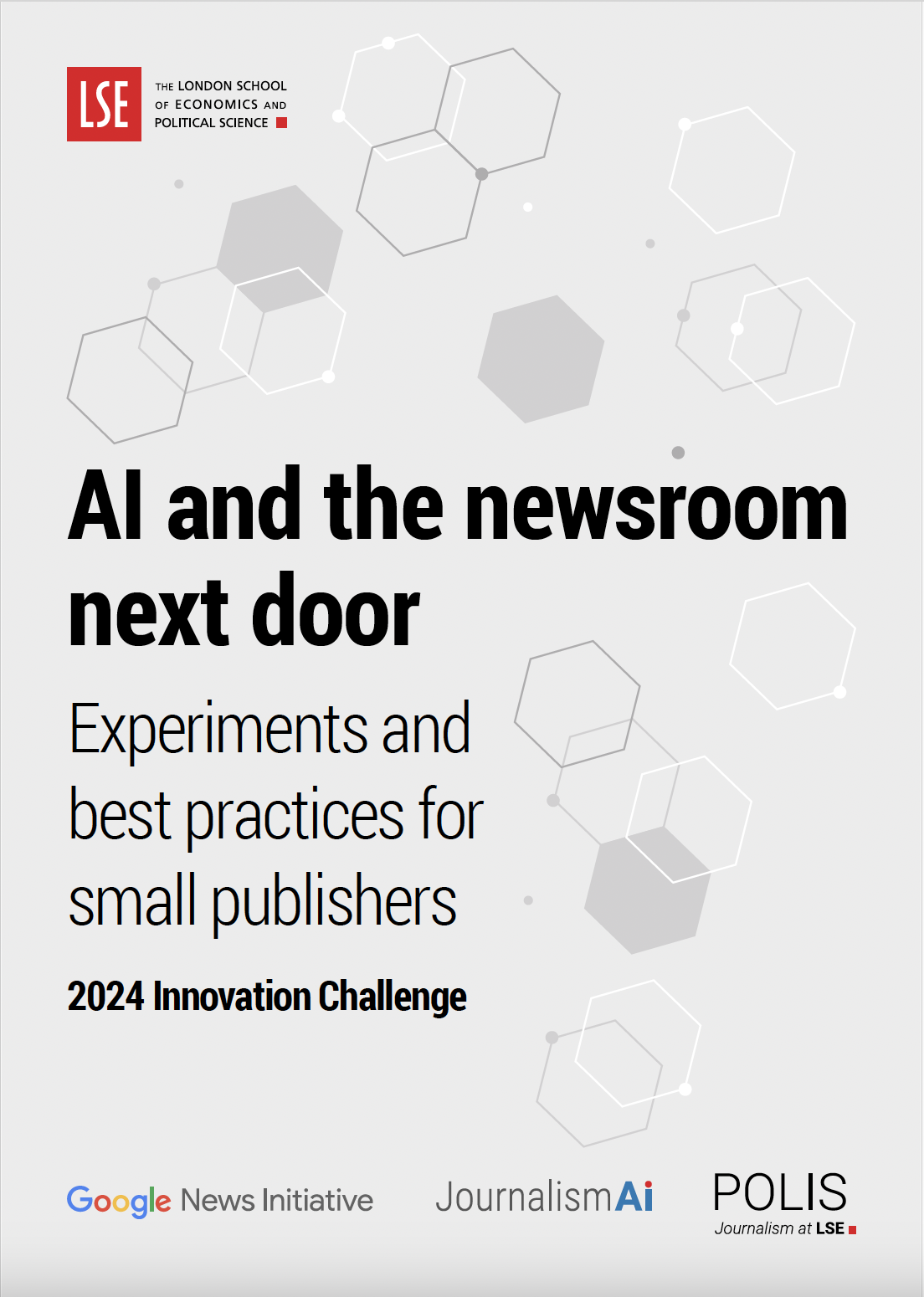
Find our 2024 Innovation Challenge grantees, their journeys and the outcomes here. This grantmaking programme enabled 35 news organisations around the world to experiment and implement solutions to enhance and improve journalistic systems and processes using AI technologies.
The JournalismAI Innovation Challenge, supported by the Google News Initiative, is organised by the JournalismAI team at Polis – the journalism think-tank at the London School of Economics and Political Science, and it is powered by the Google News Initiative.
